CARMABI’s annual coral spawning predictions are out now! Based on last year’s surveys and over 30 years of observations, we have come up with predictions for the dates and times when many Caribbean coral species will produce the next generation of corals.
1) Please complete our short community survey first. This helps us answer your questions, measure our impact, and keep you updated when future calendars are released. Last year, we had >180 downloads from 20 countries and territories!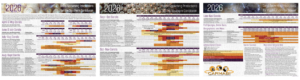
2) Click here to download CARMABI’S 2026 Coral Spawning Predictions for the Southern Caribbean. Note that these predictions are only applicable to the Southern Caribbean region and that spawning events of some species remain difficult to predict.
Introduction to this year’s predictions: Dear spawning community: Whew! Disease and bleaching continued to stress our region throughout 2025. Spawning looks different than it did just a few years ago. Overall, corals on remote, protected, and healthier reefs are continuing to spawn “on time” on their predicted dates and times. Corals in urban, stressed, overfished, and polluted sites are spawning more sparsely, if at all, but they are still generally “on time” when they do spawn. If your joy, your job, or your photo album depend on coral spawning, we suggest seeking out the densest populations you can access, and diving a few extra nights to be sure you find what you’re after. Also pay close attention to late August and late September, when the full moons occur just after midnight. Corals will “feel” the full moon a night early – we suggest starting dives one to two nights earlier than usual to catch them. Wishing a prolific spawn to all!
Tips for observing coral spawning:
- Spawning is never guaranteed, especially in a changing climate. When in doubt, go for a dive.
- Our predictions span the known range of spawning times without an added buffer; be sure to enter the water before the predicted spawning time.
- Dive in a place with high coral cover.
- Make multiple dives on multiple nights.
- Dive shallower than 50′ to maximize dive time.
- Use a moderately bright dive light.
- Scan the water column for clouds of spawn and trace them back to the colony that released them.
- Spawn from most brain/star/elkhorn/staghorn corals looks like snow/confetti/polka dots.
- Spawn from starlet, pillar, maze, and pineapple corals and male great star corals looks like puffs of smoke or sprays of fine sand.
- Spawn from female great star corals looks like chunky vomit (hooray!).
- Spawning depends on local sunset times; to adjust dives based on your local sunset times, visit www.timeanddate.com.
More community resources:
Coral breeding reference sheets: This new community resource for coral propagation, led by Val Chamberland, is now available to download here for the following species:
Acropora palmata
Orbicella faveolata
Diploria labyrinthiformis
Porites porites
Spawning community Q&As on Facebook: As fall spawning ramps up, we’ll be answering spawning and larval propagation questions here on the Coral Spawning Research Facebook page.
Last year’s Q&A’s are available below:
Spawning Q&A Week 1
Spawning Q&A Week 2
Spawning Q&A Week 3
Spawning Q&A Week 4
Spawning Q&A Week 5-7
Spawning Q&A Week 8